November 15, 2026
997 Turbo Manual vs Tiptronic: Why the Slower Car Costs $50K More
The Tiptronic 997.1 Turbo is quicker to 60, yet the manual sells for about $50K more. Here's why, and how to spot a fake manual listing.
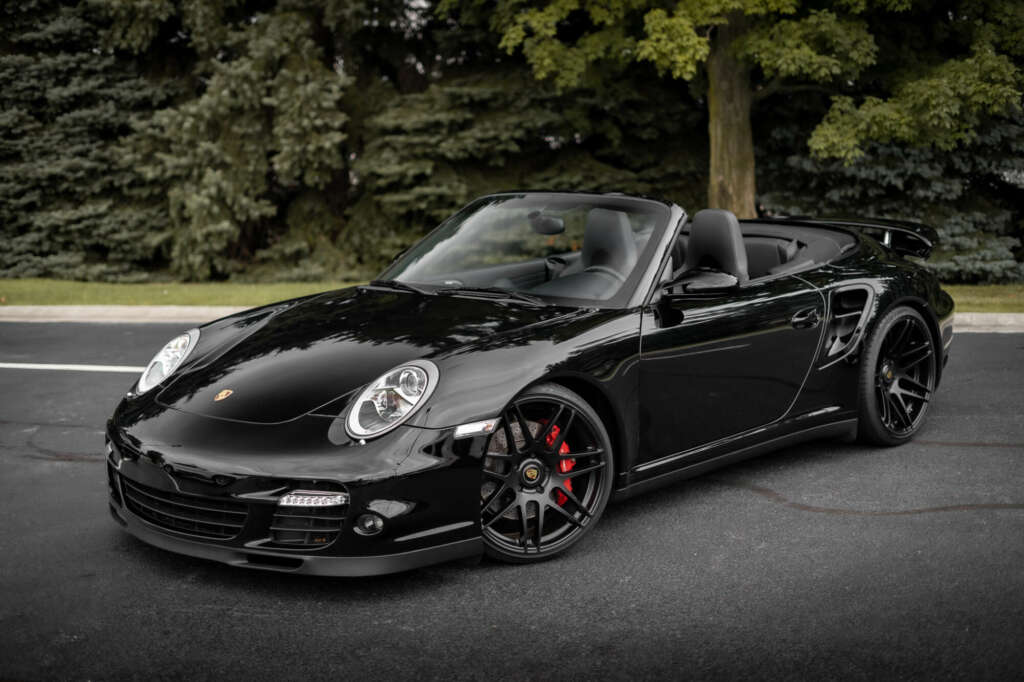
If you're shopping for a 997.1 Porsche 911 Turbo, you'll notice something strange pretty quickly. Two cars from the same generation, and one costs tens of thousands more than the other. And the expensive one is the slower car.
That's not a typo in the listings. It's how this market actually works, and if you understand why, you're much less likely to overpay.
The numbers
The 997.1 Turbo was sold from the 2007 to 2009 model years in the US. You could get it with a six-speed manual or a five-speed Tiptronic S automatic.
According to Porsche's own figures, the Tiptronic does 0 to 60 mph in 3.4 seconds. The manual does it in 3.7. In metric, that's 3.7 seconds to 100 km/h for the Tiptronic and 3.9 for the manual. At launch, this was a big deal. It was the first time an automatic Porsche was quicker than the manual version of the same car.
The Tiptronic is also the heavier car. Around 1,620kg for the Tiptronic coupe against 1,585kg for the manual. It still wins the sprint.
Now look at the prices. As of November 2026, classic.com's market benchmark puts a 997.1 Turbo coupe with the manual at $122,475. The Tiptronic coupe sits at $73,185. That's a gap of roughly $49,000.
So the market is paying about $50,000 extra for a car that's 0.3 seconds slower to 60.
Why the manual is worth more
It comes down to the engine and what came after it.
The 997.1 Turbo uses the Mezger engine. It's the twin-turbo flat six that traces back to Porsche's GT1 race car, and it has a reputation for being incredibly tough. Porsche fans talk about the Mezger the way Ferrari fans talk about a gated manual.
For the 2010 model year, the 997.2 Turbo moved to a new direct-injection engine. That means the 997.1 was the last 911 Turbo built with the Mezger. And if you want that engine in a 911 Turbo with a manual gearbox, this is the only place you'll find it. Porsche never made that combination again.
That's what collectors are paying for. Not the acceleration time. The Tiptronic is a great car to drive every day and it's faster in a straight line. But the manual is the one with a story, and the story is what holds value.
One honest note. Manual premiums across the 911 range have been shrinking a little each year as newer automatic gearboxes get better. So I wouldn't buy a manual 997 Turbo expecting the gap to keep growing. Buy it because it's the car you want, and know you're paying for something that's genuinely limited.
The trap: listings that say "manual" on a Tiptronic
This is where people lose money.
The Tiptronic has buttons on the steering wheel that let you change gear yourself. Because of that, some sellers and dealers list Tiptronic cars as "manual". Sometimes it's a mistake. Sometimes it's lazy data entry. Owners on Rennlist have pointed out that when you search listing sites for manual cars, a lot of the results turn out to be Tiptronic or PDK cars for exactly this reason.
With a $50,000 gap between the two, one wrong word in a listing can cost you a lot.
The fix is simple. Before you even message the seller:
- Open the interior photos.
- Count the pedals. A manual has three. A Tiptronic has two.
- Look at the gear lever. A Tiptronic has a P, R, N, D gate. A manual has a normal shift pattern.
If you only count two pedals, it's a Tiptronic. Either walk away or pay Tiptronic money for it.
If you want more checks like this, I wrote a full guide on how to read a supercar listing.
Shopping for a supercar right now? I keep a free list of 20 supercars I think are mispriced. Get the free list.
One more thing to check: conversions
Some 997 Turbos have been converted from Tiptronic to manual over the years. On those cars, you'll see three pedals in the photos, even though the car didn't leave the factory that way.
Most buyers won't pay full factory-manual money for a converted car. So if a manual 997.1 Turbo looks right, ask the seller for the Porsche Certificate of Authenticity or the original build sheet. It shows how the car was specified when it was built, including the gearbox. If the paperwork says Tiptronic and the car has three pedals, you're looking at a conversion, and the price should reflect that.
FAQ
Is the Tiptronic 997 Turbo a bad car? No. It's quicker in a straight line and easier to live with in traffic. It's just worth a lot less on resale, so price it accordingly.
Does the 997.1 Turbo have IMS bearing problems? No. The Mezger engine in the Turbo doesn't use the IMS design that causes problems in the regular 996 and early 997 Carrera engines. That's a big part of why people love it. If you're comparing Carreras instead, I covered the 997.1 vs 997.2 Carrera S separately.
Is the 997.2 Turbo a Mezger? No. From the 2010 model year, the 997.2 Turbo uses a new direct-injection engine. The 997.1 is the last 911 Turbo with the Mezger.
How can I tell if a 997 Turbo is a real manual? Count the pedals in the interior photos (three for a manual, two for a Tiptronic) and check the gear lever. To rule out a conversion, ask for the Porsche Certificate of Authenticity or the original build sheet.
My take
From an investment point of view, I'd definitely go for the manual. But I wouldn't drive it much, simply because I haven't mastered driving manual yet, and I would hate to accidentally do a money shift. If this is the car I'll drive day to day, I'll definitely go with the Tiptronic. It's faster, it's cheaper, it's still a Porsche, and I won't be worried about driving it "perfectly". But hey, that's just me.
Sources
- Classic.com: Porsche 911 Turbo Coupe, Manual, 997.1 market
- Classic.com: Porsche 911 Turbo Coupe, Tiptronic, 997.1 market
- SAE: Turbocharging the 911 (official acceleration figures)
- Philip Raby: Porsche 911 Turbo 997 Gen 1 (specs and weights)
- Elferspot: 997.1 Turbo, last Mezger 911 Turbo with a manual
- Rennlist: manual listings that turn out to be Tiptronic or PDK
- RennPulse: how much a manual is actually worth
Shopping for a supercar? I put together a free list of 20 supercars I think are mispriced right now. Get the list here.